
Klamath County Court Records After Jail Arrest
The local path starts with a police report and, if the person is taken into custody, a booking at Klamath County Jail. The Klamath County District Attorney criminal-case process says police agencies investigate and forward reports to the District Attorney's Office. A Deputy District Attorney then reviews the report and decides whether there is enough proof to charge the person with a crime. That filing step is what turns an arrest into a court case.
The jail roster and the court record answer different questions. A booking record may show custody status, booking number, person descriptors, and arrest or detention charges. The court record shows what the prosecutor filed for the State of Oregon, when arraignment occurred, whether future dates were set, and how each charge moved. For the custody side, use Klamath County jail inmate records. For booking-photo questions, use Klamath County jail mugshots. The court record is the better source for charge status and disposition.
The county's local justice offices are split by function. Jail custody, bail intake, and booking questions route to the Vandenberg Road jail. Court records, arraignment files, and case copies route through the courthouse on Main Street. That split matters after an arrest in Klamath Falls, Merrill, Malin, or elsewhere in Klamath County because a person can be booked in one system while the formal case is opened in another.
Find Klamath County Court Records After Arrest
The main public court channel is the Oregon Judicial Department Online Records Search. It provides free limited case information. Oregon also uses OECI/OJCIN for official register access by login or subscription. The Klamath County Circuit Court page gives the local fallback: two OJCIN public access computers are available in the courthouse lobby, and most circuit court case information and many filed documents can be reviewed there when they are not protected.
The inspected court portal materials did not expose every web-form field in text capture, but the research confirmed Smart Search access on the public portal, User ID and Password fields on the OECI/OJCIN login, and in-person public terminals at the courthouse. Use the name spelling from the jail roster when possible. A booking number is useful for the jail, but the court case will usually be found by defendant name or case information once the prosecutor files the charging document.
- Check the jail roster first for the booked name, booking date, and arrest or detention charges.
- Search Oregon Online Records Search for limited public case information after the District Attorney files charges.
- Use OECI/OJCIN or the Klamath courthouse public computers when the free search is too thin.
- Request copies from the court when a complaint, information, indictment, docket entry, or judgment is needed.
- Use Oregon State Police CJIS for a statewide criminal history check when a broader record search is required.
For visual context, the Oregon Online Records Search portal is the free statewide starting point for limited case information.
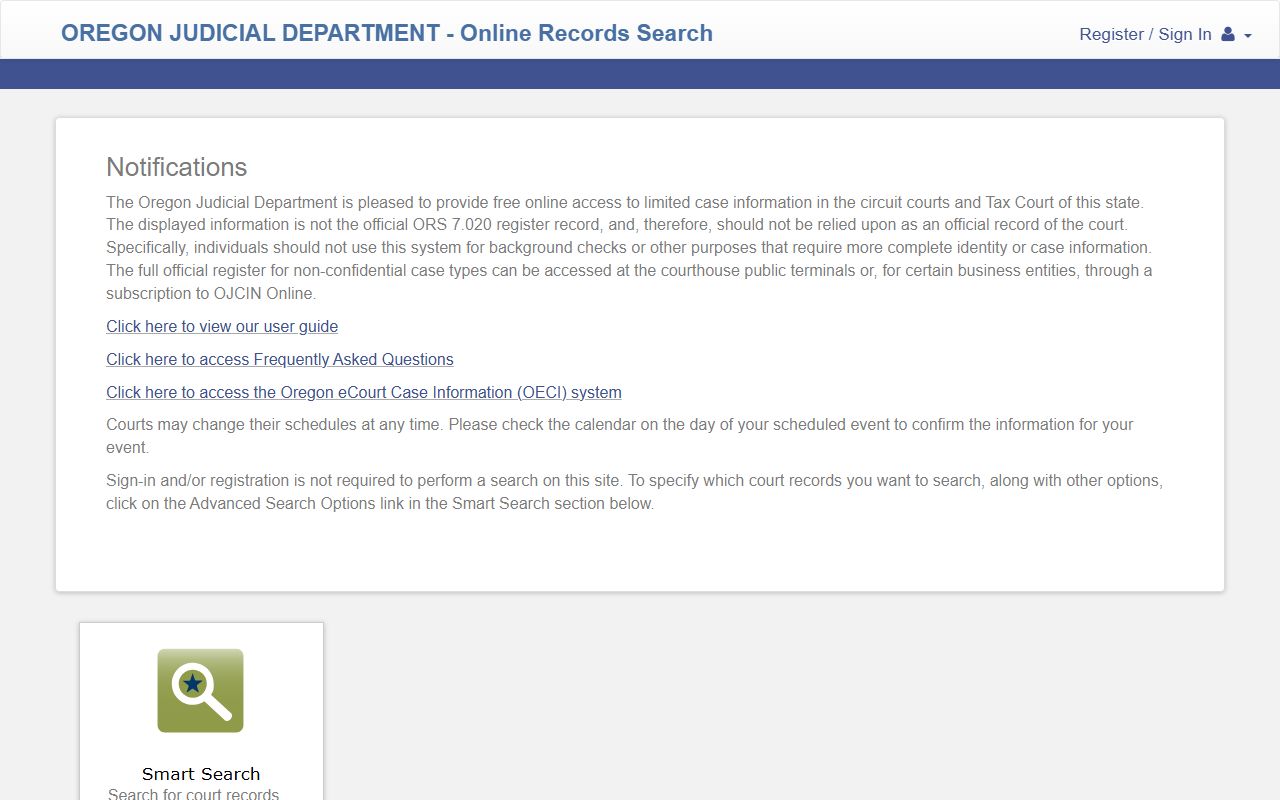
The screenshot shows why the online court search should be treated as an index, not as a full official file. More complete court records may require OJCIN access or a court records request.
Klamath County Arrest Charges and Court Records
The District Attorney page states that a criminal case begins when the DA files a charging document on behalf of the State of Oregon. At arraignment, the defendant is advised of the criminal charges and usually gets future court dates. Some cases may resolve by a guilty plea at arraignment. If the person qualifies financially, counsel can be appointed unless representation is declined.
Felony cases and misdemeanor cases do not move in the same way. The Klamath County DA explains that a felony is a crime designated by law as a felony or one that can lead to more than one year in prison. A misdemeanor is designated a misdemeanor or can lead to no more than one year in custody. Felony charges require enough evidence through a preliminary hearing or grand jury path. Misdemeanor cases do not use that step in the same way.
| Document | Who Uses It | What It Means After Arrest |
|---|---|---|
| Complaint | Prosecutor in court | Often starts a criminal case with the charges the State of Oregon is pursuing. |
| Information | District Attorney | Formal charging document filed by the prosecutor, often used after review of police reports. |
| Indictment | Grand jury process | Used when the grand jury returns charges, most often in felony practice. |
The District Attorney's case-process page lays out the local arrest, report-review, charging, arraignment, trial, and sentencing flow.
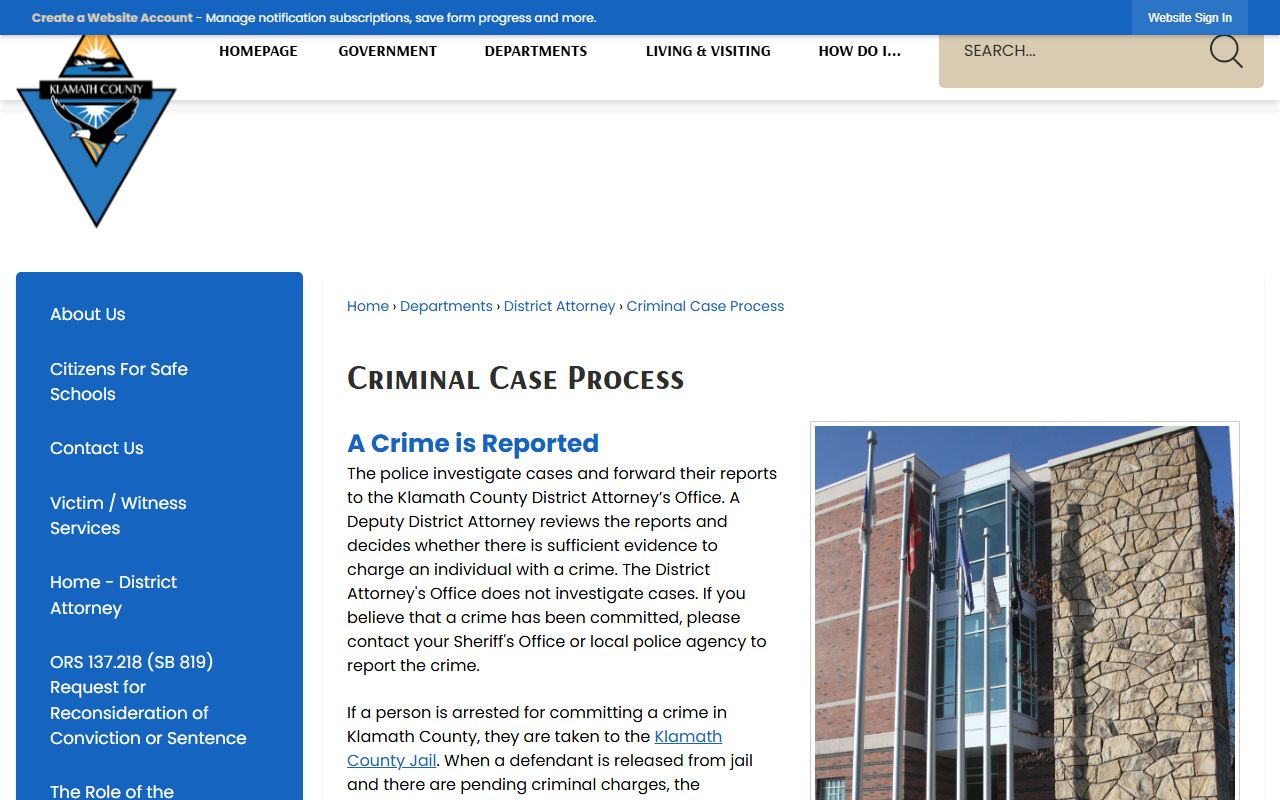
That local sequence is the reason court records after a jail arrest should be checked after, not instead of, the booking record.
Klamath County Charge Status Records
Charge status can change after the first booking. The jail roster may list the arresting agency's starting charge, while the court file reflects the DA's charging choice and later court action. A charge can be filed as written, reduced, amended, dismissed, resolved by plea, or decided at trial. A court record is therefore the right source for the current posture of the case.
| Status | Plain Meaning | Where to Verify |
|---|---|---|
| Pending | The charge is active and the case has not reached final disposition. | Oregon Online Records Search, OJCIN, or court clerk records. |
| Amended or reduced | The filed charge changed from an earlier version or became a lesser charge. | Case register and filed documents. |
| Dismissed | The court case no longer proceeds on that charge, though other charges may remain. | Court docket and final order. |
| Convicted | The charge ended in a guilty plea, verdict, or other conviction entry. | Judgment or official court register. |
Note: A jail booking charge is not the same as a final Klamath County court disposition.
Klamath County Bond, Warrants, and Arrest Records
Klamath County has detailed local bail instructions. The jail accepts bail at any time for a person held in Klamath County Jail. The county says a third-party bail poster must appear at the jail, read a court form, sign as the bail poster, and understand that legal effects can follow. If money is posted, the bail is taken to Klamath County Circuit Court or County Finance. Questions about bail status then route to the court, which holds posted bail until the case ends and may retain fines, fees, or court costs before refund.
There is no official Klamath County active warrant search page in the research. Warrant checks should use official channels rather than third-party warrant sites. A person arrested on a warrant can appear in the Web Jail Viewer after booking. Bench warrants often tie back to a court case, so court records and OJCIN can show public warrant-related docket events when available. The jail transport page also says a person arrested on another county's warrant may be moved by the Klamath County Jail Transport Unit, sometimes within one day and sometimes after several weeks.
- Bail posted at Klamath County Jail
- The Klamath bail procedures route the posting step through the jail bond door, while bail status questions go to the court.
- Bench warrant
- This type of warrant is often tied to failure to appear or a court-order violation in an existing case.
- Other-county warrant
- Jail and transport records may show custody, but transfer timing is not disclosed for security reasons.
- Federal fugitive context
- The U.S. Marshals District of Oregon lists Klamath County Sheriff's Office as an Oregon Ad Hoc Fugitive Task Force participant.
Klamath County Charges vs Convictions
An arrest is not a conviction. A filed charge is an accusation that enters the court record after review by the prosecutor. A conviction is the result of a guilty plea, verdict, or other final criminal judgment. The Web Jail Viewer warning is consistent with this point: people shown in jail records have been arrested but have not necessarily been found guilty.
| Comparison | First Item | Second Item |
|---|---|---|
| Charge vs conviction | A charge is an accusation filed after police report review. | A conviction is a final outcome through plea, verdict, or judgment. |
| Best source | Charging document and case register. | Judgment, disposition, or official register. |
| What it proves | The State of Oregon accused the person of an offense. | The charge ended in a finding of guilt. |
| Sealed vs expunged | A sealed or protected record is hidden or limited by court order or law. | A set-aside or expunged record may be removed from public access under the order. |
| What to verify | Check the court order and clerk access rules. | Check the final order and Oregon eligibility rules. |
Klamath County Sealed and Expunged Records
Oregon public records law begins with a right to inspect public records, but it also allows exemptions and redactions. ORS 192.314 gives the general inspection right, while ORS 192.345 and ORS 192.355 list records that may be conditionally or fully exempt. Juvenile records, protected identity data, ongoing law-enforcement material, medical information, and some sealed court records can be restricted.
Sealing and expungement are related but not identical ideas. In practical public-search terms, both can reduce public visibility, but eligibility depends on Oregon law and the exact case outcome. Court records after a jail arrest should not be treated as clear or cleared until the court file confirms the disposition and any sealing or set-aside order.
For public records that remain open, use the online court search, OJCIN, the courthouse terminal, or a clerk copy request. For protected records, the clerk's access rules and the text of the court order control. For set-aside or expunged records, the final order is the key record because it defines how the case should appear in later public searches.
Klamath County Court Records Access Limits
Oregon has several layers of access. The free online court search is limited and is not the official ORS 7.020 register. OECI/OJCIN is the official register path for Oregon circuit courts and the Tax Court. Klamath County Circuit Court also provides two public OJCIN terminals in the courthouse lobby, with protected information withheld and copies handled through records requests.
For statewide criminal history, Oregon State Police CJIS is separate from court case search. The research notes a fee-based process for a copy of your own Oregon record or another person's limited public Oregon criminal history, with fingerprint requirements for copy-of-own requests. That route is broader than one Klamath County arrest, but it is not a substitute for the filed court case.
Important: Klamath County Inmate Population is not a consumer reporting agency, and court or custody information must not be used for FCRA-covered decisions.